Vision Disability

What to Ask During Your Vision Disability Consultation

Getting a clear view of the world is deeply important for daily success. Sometimes normal glasses just do not fix the root problem. People often face extra stress when reading books or taking long tests. A vision disability consultation helps uncover real answers to these frustrating issues. This special eye visit provides the paperwork you need for school accommodations or workplace changes. Walking into this appointment completely ready is the best plan. Knowing exactly what to ask makes a huge difference in the final results. Expect the best guidance from trusted experts like Dr. Marianna Konradi at Vision 2C. This clinic focuses purely on personalized care for the whole family.

When sitting down for a vision disability consultation, ask the doctor what is causing the visual stress. Ask if specific therapies will help. Ask how to get official paperwork for school or work support (like extra test time or screen filters). Finally, ask how many days it takes from start to finish to get the printed medical report.

Why a Vision Disability Consultation Matters

Big school exams and long work days require excellent eyesight. When eyes feel tired quickly (or cause sharp headaches while reading), special help becomes necessary. Vision 2C offers complete and advanced evaluations. These visits go far beyond a normal eye check. They look closely at how the eyes work together during difficult tasks.

Proper testing uncovers hidden visual stress. This stress ruins reading performance during standardized exams. An official doctor’s report changes everything. The right consultation provides the exact paperwork needed to get helpful tools. These tools make a massive impact on daily life. Proper support brings back confidence in the classroom and the office.

Top Questions About General Eye Health

Asking the right questions during the visit is a top priority. Writing these points down before seeing the eye doctor saves time. It also ensures no important details are forgotten.

  • What exact vision problem is causing this severe reading stress?
  • How does this specific eye issue change daily life routines?
  • Are there targeted therapies that will safely improve overall sight?
  • Will the eye condition naturally get better over a long time?
  • Is a sensorimotor exam required to check how the eyes work as a team?
  • Do contact lenses offer a better solution than normal glasses for this issue?

Important Questions for School Accommodations

Students face very tough challenges when dealing with unseen vision problems. Dr. Konradi has fifteen years of deep experience helping students succeed. She actually worked as a teacher for visually impaired children. This incredible background makes her the perfect person to ask about school assistance.

  • What kind of special help exists for standardized tests like the ACT?
  • Can the clinic write a detailed report asking for a test scribe?
  • Will this official documentation grant extra time on difficult school exams?
  • How often do these school reports need a fresh update?
  • Does the clinic offer specific School Test Help services for teenagers?
  • What steps happen if the school board rejects the first doctor’s note?

Inquiries for Workplace Vision Support

Adults absolutely need comfortable vision to do their jobs well every day. Staring at bright computer screens all day causes serious strain. Knowing how to protect the eyes while working is a major key to health.

  • What specific screen filters will help reduce daily office eye strain?
  • Can the doctor provide a note requesting softer lighting changes in the building?
  • How many screen breaks do the eyes truly need during an eight hour shift?
  • Does the current eye condition qualify for official workplace disability support programs?
  • Are there special computer glasses that reduce harsh visual glare?

Asking About the Official Documentation Process

Getting the correct paperwork remains the most important part of the entire visit. Schools and big testing boards demand very strict proof of any disability. Asking the doctor exactly how this process works prevents future delays.

  • How many days does it take to get the final typed disability report?
  • Does the clinic mail the papers directly to the state testing board?
  • What exact medical details are included in the official support letter?
  • Is there an extra fee for filling out long disability forms?

How Vision 2C Helps Patients Succeed

The friendly team at Vision 2C gives highly personalized care. No one is ever rushed through a complicated appointment. The clinic uses very modern diagnostic technology to find the exact cause of visual stress. Patients get honest answers (and clear treatment plans) for long term eye health.

Booking a visit at the Brewer or Thomaston location serves as the perfect first step. Securing proper school test help or workplace support is completely possible. Poor vision should never hold anyone back from reaching high goals. Excellent service and a family friendly environment make the whole process totally stress free.

FAQs

Q. What is a vision disability consultation?

This is a special medical visit. It checks for hidden vision problems that make reading or testing very difficult.

Q. Who needs this specific type of eye exam?

Students taking big tests and workers dealing with screen strain need this exam. It helps secure special tools for daily tasks.
Eye Exams

Can Routine Eye Exams Detect Eye Problems Before Symptoms Appear?

You may be wondering if routine eye exams can catch eye problems before any symptoms show up and the answer to that is a very strong yes. Many serious eye problems develop quietly, without causing pain or blurry spots. You could feel perfectly fine while a hidden problem gets much worse inside your eyes. We at Vision 2C use complete checkups to spot these hidden dangers early. Catching these quiet issues right away gives us the absolute best chance to protect your vision. According to the Centers for Disease Control and Prevention (cdc.gov), regular visits to your eye doctor remain the most effective way to catch vision problems early on.

Why Do Some Eye Problems Hide Their Symptoms?

Sometimes, your eyes play tricks to make you think everything is completely fine. Your brain is incredibly smart (maybe a little too smart sometimes) because it naturally works to cover up small vision changes. If one eye loses a tiny bit of sight, your other eye simply works much harder to fix the mistake. You will probably not notice the missing vision until the damage becomes very severe.

Furthermore, the inside of your eye does not have normal pain receptors. High pressure inside your eye can slowly damage your optic nerve without causing a single headache or any discomfort at all. This lack of pain is exactly why waiting for blurry vision is a dangerous choice for your health.

Silent Eye Diseases We Catch During a Routine Exam

We check for several quiet diseases during your visit to Vision 2C. Our complete vision care looks far past your basic glasses prescription to make sure your entire eye stays healthy for life.

Here are common eye conditions that easily hide their early warning signs:

  • Glaucoma: This sickness increases the fluid pressure inside your eye (which damages the optic nerve over time). You lose your side vision so slowly that you rarely notice it happening until it is too late.
  • Macular Degeneration: This condition breaks down the very center of your retina. It causes bad blind spots in your central vision as you get older. We can easily spot the early signs of aging in your eye before those blind spots ever form.
  • Diabetic Retinopathy: High blood sugar damages the tiny blood vessels inside your eyes. The National Institutes of Health (nih.gov) warns that diabetic eye disease often has no early warning signs at all. We look very closely for leaking blood vessels during your exam.
  • Cataracts: The clear lens inside your eye slowly becomes cloudy as you get older. We track this clouding long before you actually need surgery to fix it.

What Actually Happens During a Routine Eye Exam?

Surprisingly, many people think an eye exam just means reading black letters on a wall chart. That reading test is only a very small part of the entire process. We perform several painless tests to check the overall health of your eyes.

Our careful exam process includes these important steps:

  1. Visual Acuity Testing: We measure exactly how clearly you see objects at different distances.
  2. Eye Pressure Checks: We measure the fluid pressure inside your eyes to watch for glaucoma risks.
  3. Pupil Dilation: We use special drops to open your pupils wider (which lets us see the back of your eye much better).
  4. Retinal Evaluation: We shine a safe light to check your retina and optic nerve for hidden damage.

How Vision 2C Protects Your Eyesight

Experience matters greatly when searching for hidden eye problems. Dr. Marianna Konradi brings over 15 years of vision care experience to every single appointment. We never rush you through your visit because we want to understand your concerns completely. We take the time to look closely at every part of your eye and explain your health clearly.

We offer a full range of eye health services to keep you seeing clearly at every stage of life.

Our core services include:

  • Routine Eye Exams: We check your overall eye health and update your vision prescriptions.
  • Ocular Disease Management: We closely monitor and treat eye diseases to save your precious vision.
  • Sensorimotor Exams: We evaluate exactly how well your eyes work together as a matching team.
  • Contact Lens Exams: We provide expert fittings so your daily lenses feel completely comfortable all day long.

How We Help Children and Students Succeed

Usually, children do not know they have a vision problem because they think everyone sees the world exactly the way they do. Poor vision can cause massive struggles in the classroom and during test time. We proudly offer specific School Test Help to address visual stress that ruins reading performance.

Dr. Konradi has a deep background as a former teacher of the visually impaired (making her uniquely qualified to help children succeed). Through complete vision assessments, we help improve reading comfort for students. We provide the necessary paperwork to support special help that allows students to perform confidently on standardized tests like the ACT.

What Else Can an Eye Exam Reveal?

It’s interesting how much your eyes can tell you about your whole body. The eye is the only part of the human body where a doctor can look directly at your blood vessels and nerves without making a cut. Sometimes we can see general health problems before your regular family physician does.

Routine exams can uncover early signs of:

  • High blood pressure
  • High cholesterol levels
  • Thyroid disease
  • Autoimmune conditions

How to Prepare for Your Visit with Us

Honestly, getting ready for your eye appointment is very easy. You can do a few simple things to make your visit go smoothly. First, you should bring your current glasses or contact lenses with you. We need to see what you are wearing right now to know if your prescription needs to change.

Second, please bring a list of any medicines you currently take. Certain medicines can cause dry eyes or other vision changes and we need this information to give you the best care possible. Finally, you might want to bring a friend or family member to drive you home if we need to dilate your eyes.

Trust Vision 2C for Your Family Eye Care

Vision 2C proudly serves the wonderful communities in Brewer and Thomaston, Maine. We focus on giving you personalized care in a very comfortable and welcoming environment. Our team knows exactly how to make eye exams completely stress free for children, adults and seniors alike. We believe in building lasting relationships based on deep trust and outstanding patient satisfaction.

Ready to stop squinting and having constant headaches every afternoon? Book your eye exam today with Vision 2C. Let us help you see clearly so you can live and think clearly.

FAQs

Q. What is glaucoma?

It is high pressure in the eye. It hurts your side vision very slowly. You may not notice it at first.

Q. What does a cataract do?

A cataract makes the clear part of the eye cloudy. An exam tracks this as you get older.

Eye Exams

When Should Children Start Getting Regular Eye Exams?

Because you’re a caring parent, you want the absolute best for your lovely, growing child, you always take them to the family dentist and monitor their height and weight. But what about their precious eyes? Many parents have absolutely no idea when to schedule the very first eye doctor visit, even though good vision is a major part of growing up safely. Let us look right now at the best times to book these important checkups to protect your family.

The Best Timeline for Your Child’s Eye Exams

Knowing exactly when to book an eye doctor visit is surprisingly tough. Babies cannot talk. They can’t tell you if a colorful toy suddenly blurs. Therefore, those proactive checkups are absolutely vital for healthy development.

  • Six Months Old: Your baby needs their first eye exam so the doctor can gently check if their eyes focus properly.
  • Three Years Old: Toddlers should see the doctor again to play simple visual games that test their growing sight.
  • Five or Six Years Old: This important visit happens right before kindergarten because clear vision helps your child read books easily.
  • Every Year after That: Children need an exam every year since kids grow fast, and their eyes change just as fast.

Why School Screenings Are Not Enough

School vision tests screen out subnormal distance vision, but countless other visual issues, especially those at close range, may tragically go undetected. Standard checks do not verify whether both eyes work together as a cohesive unit. They lack depth.

A comprehensive visit to the eye doctor provides far better insights. Doctors rigorously assess gaze shifts and visual concentration needed to read small print. You should always trust proper medical exams to catch those hidden problems that basic school tests are not designed to catch.

Signs Your Child Might Need Glasses

Sometimes kids do not know they have a vision problem because they safely assume everyone sees the world exactly like they do. Parents must play detective at home, so if you notice any of these visual clues, be sure to book an appointment right away:

  • Sitting very close to the television screen or holding a favorite storybook right up against their nose.
  • Squinting their eyes to see things far away across the room and rubbing their eyes a lot throughout the day.
  • Crying about painful headaches upon starting homework or losing their spot while reading lines of text.

How Vision Connects to School and Learning

Picture the intense visual toll of an average school day. Kids constantly scan the front boards, scan lines of text and fill lined paper. It is exhausting. When poor vision strikes, learning becomes brutally hard. The sensory confusion of blurred vision can closely resemble behavioral issues or significant learning delays. Students simply zone out in class. Their overworked eyes physically ache, and prompting a complete shutdown, they stop looking at coursework.

Getting those proper prescription glasses can change the game, easing the underlying issue and rapidly rebuilding classroom confidence. Learning can feel genuinely fun to do once more.

Protecting Little Eyes from Screens

Kids use tablets and computers every single day, but looking at bright screens for hours makes eyes tired while causing dry eyes and painful headaches. Doctors call this digital eye strain and an eye doctor can give you great tips to keep your child’s eyes totally safe. They might teach you the twenty-twenty-twenty rule, which means that every twenty minutes, you look away from the screen at something twenty feet away for exactly twenty seconds. This simple, easy habit gives the eyes a much-needed rest during long screen time sessions.

Getting Help with Standardized Tests

Older kids take big state tests and sometimes they sit for long exams to get into a good college. If their eyes do not work together well, reading a long test becomes exhausting because their eyes get tired and they lose focus fast. Some eye doctors can test your child for this exact problem and write a special medical report for the school. This report asks the school to give your child extra time, which gives your child a fair chance to succeed without unnecessary eye pain.

What to Expect at the Eye Doctor

Taking a young, nervous child to a brand new medical office can be scary, but eye exams are genuinely fun and they do not hurt at all! Here is exactly what happens during your family visit:

  1. The doctor smiles warmly and asks you a few simple questions about your child’s health and daily habits.
  2. They use fun, light-up toys to easily grab your baby’s attention and track their eye movements.
  3. Older kids get to read standard letters or point at fun pictures on a big wall chart.
  4. The doctor puts different lenses in front of your child’s eyes to see what looks the absolute clearest.
  5. They shine a small, gentle light into the eye to ensure the inside is perfectly healthy.

How Vision 2C Supports Your Family

When you need a friendly, caring eye doctor, Vision 2C is totally ready to help you with complete vision care for your whole family. Dr. Marianna Konradi has spent fifteen wonderful years helping people see better and she used to be a dedicated teacher for visually impaired children. This unique background makes her perceptive and deeply patient with kids of all ages.

At Vision 2C, we offer Routine Eye Exams to keep your child’s eyes perfectly healthy, along with special Sensorimotor Exams. These specific tests check how well your child’s eyes work together for reading, so if your child struggles in class, we can help find out exactly why. We also offer School Test Help and disability consultations to provide the proper reports that get your child the extra time they deserve. We never rush you through your appointment, so book your visit with Vision 2C today and protect your child’s beautiful sight.

FAQs

Q. Are school eye tests good enough?

No. School tests are a great first start. They usually check visual acuity and eye alignment from far away. An eye doctor checks additional visual functions at various distances.

Q. How can families keep eyes safe from screens?

Use the twenty-twenty-twenty rule. Look twenty feet away for twenty seconds. Do this every twenty minutes.

Vision Rehabilitation

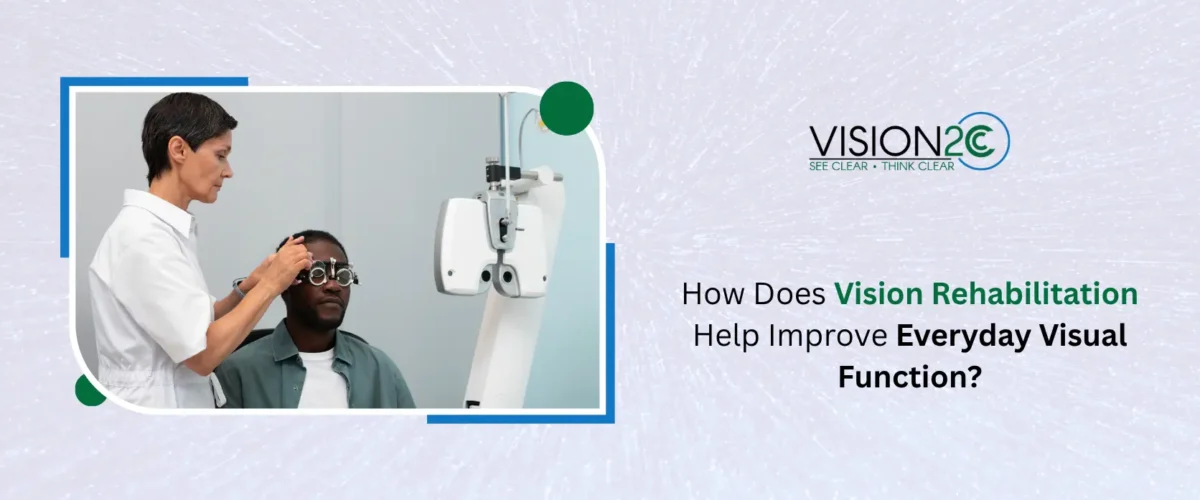
How Does Vision Rehabilitation Help Improve Everyday Visual Function?

Having clear sight makes life much easier since we use our eyes for everything from the moment we wake up until we go to sleep at night. Standard glasses or basic contact lenses are sometimes not enough to fix our sight problems, and extra medical helps step in to save the day. If you wonder how you can make your eyes more reliable for everyday tasks, vision rehabilitation is a special type of eye care that helps people see better and live happier lives. Let us explore how this amazing care changes lives for the better by relieving eyestrain, increasing visual endurance, and boosting confidence.

What Is Vision Rehabilitation?

Think of this special care like physical therapy for your eyes and your brain. When you hurt your leg, you may do specific exercises to make it strong again, and your eyes may be strengthened in a similar fashion. Sometimes the brain and the eyes do not talk to each other very well and this lack of teamwork causes a lot of unwanted stress in your head. Additionally, if you have lost vision due to disease, you may benefit from handheld, headborne, or desktop devices that clarify small details.

Vision rehabilitation can fix broken connections with fun exercises that train your eyes properly. This simple training helps your eyes

track objects, focus on small words and work together as a perfect team. It is not just about making things look sharp on a wall chart; it is about making your daily life comfortable again. Ultimately, this training helps kids do much better in school while helping adults focus better during a long day at work.

Supplementing lost vision with video magnification devices is often seamless, as video autofocus is typically easy to adapt to. Magnification lenses may take a bit more practice.

Why Good Vision Matters for Your Daily Life

We rely on our eyes for almost every single task we do, so think about your normal day from morning to night. You receive text messages on your phone, navigate traffic on your way to the grocery store, cook dinner for your busy family and watch your favorite television shows to relax on the couch. All of these fun and normal activities require good sight.

When your eyes do not work well together, your whole body feels it. You might feel very tired by the middle of the afternoon, or you might struggle to finish reading a simple book since poor eye teamwork can drain your energy fast. When you fix these hidden eye issues, you finally get your energy back because you stop forcing your eyes to work so hard. Everything just becomes much easier and this clear sight helps you think clearly and live a wonderful life.

Signs You Might Need Extra Help with Your Sight

While some people ….., many people do not even know they have a vision problem because they think getting tired is just a normal part of reading or working on a computer. However, your eyes might be trying to tell you a very different story, so you should pay close attention to how you feel during the day.

You might need to ask your doctor for help if you notice these common signs:

  • Squinting a lot to see small words on a bright computer screen
  • Having constant headaches after reading a book for a few minutes
  • Losing your place often when you try to read a magazine
  • Feeling dizzy or sick to your stomach when looking at a phone
  • Having trouble copying notes from a classroom board at school
  • Holding books very close to your face just to see the printed letters clearly

How Sensorimotor Exams Change Your Daily Routine

To figure out the exact problem, a good eye doctor will do a sensorimotor exam. This sounds like a really big medical word, but it is actually a very simple test that looks closely at how your two eyes work as a team. It checks if they point in the exact same direction at the same time because reading becomes very hard work if your eyes do not team up properly.

A sensorimotor exam finds the hidden issues that regular eye tests always miss. Once the doctor knows exactly how your eyes move, they can create a plan just for you to help improve your reading speed. This customized plan also boosts how well you learn and understand new information, ensuring that learning becomes fun again when your eyes move smoothly across a page.

Extra Support for School and Work Tasks

Sometimes, poor sight makes taking school tests very difficult, meaning kids and teens can face huge hurdles during big exams. The stress on their eyes can make them fail even if they know all the right answers, which is where vision-related disability consultations come in handy.

An eye doctor can write a special report for the school that explains why a student needs extra help. For example, a student

might need more time on a standardized test like the ACT, or they might even need a helper to read the test out loud to them. These special school test help services ensure that visual stress does not ruin a student’s grades, giving everyone a fair chance to show how smart they truly are.

Devices for Disability

Expert Care at Vision 2C

If you live near Brewer or Thomaston in Maine, you have an amazing place to get help because Vision 2C offers complete vision care all under one roof. The clinic focuses on giving you personalized care so you are never rushed through your medical visit.

Dr. Marianna Konradi leads the amazing team at Vision 2C with over 15 years of vision rehabilitation experience. Before becoming an eye doctor, she worked as a teacher for visually impaired children, so she knows exactly how to help kids and adults succeed. She creates a friendly environment where everyone feels safe and she always takes the time to listen to your worries to build a plan that works for your life.

The Simple Steps to Better Sight

Getting help is much easier than you might think and you do not have to live with headaches and blurry words anymore. You just need to follow a few simple steps to start your healthy journey toward clear sight.

  1. Book a routine eye exam with a trusted eye doctor in your town.
  2. Tell the doctor about your headaches, blurry sight, or reading struggles.
  3. Take a sensorimotor exam to properly check your eye teamwork.
  4. Follow the customized treatment plan created just for your specific needs.
  5. Practice your daily eye exercises exactly as the eye doctor tells you.
  6. Enjoy clearer sight, faster reading speed and a much happier daily life free of strain.

Ready to See and Think Clearly?

Your eyes deserve the very best care possible, meaning you never have to struggle with your normal daily tasks alone. Good sight changes how you learn, how you work and how you feel every single day. From routine eye exams to ocular disease management, taking care of your eyes is a lifelong journey.

If you are ready to stop squinting and having constant headaches, or if you want to feel more confident at work and school, it is time to make a positive change for your health. Contact the caring

team at Vision 2C today by calling (207) 200-1492 to schedule your eye exam and let the trusted experts help you see clearly so you can live clearly.

FAQs

Q. What are the signs of por eye teamwork?

Look out for squinting or feeling sick when using a phone. Headaches and losing your place in a book are also signs.

Q. Can eye problems make school hard?

Yes! Bad eye teamwork makes reading slow and stressful. This can cause smart students to struggle on big tests.

Can Advanced Diagnostic Technology Help Protect Your Eye Health

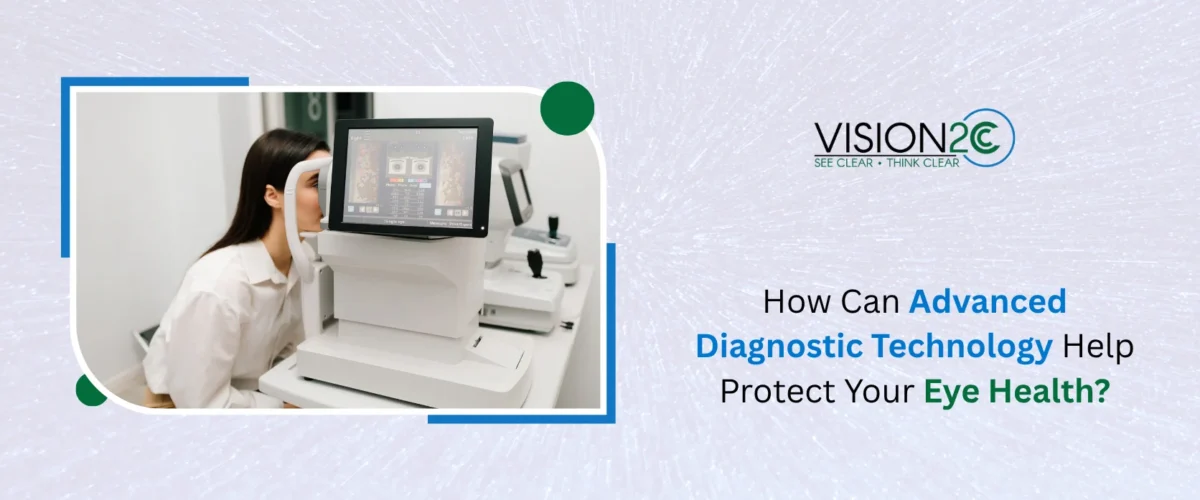
How Can Advanced Diagnostic Technology Help Protect Your Eye Health?

Eyesight is one of your most important senses because you rely on it every single day to read books, drive safely and watch your family grow. However, many people make the mistake of waiting until their vision gets blurry before they visit an eye doctor. Your eyes need regular checkups just like your teeth need a dentist to stay healthy. Technology has completely changed the way doctors check your eyes today. Advanced diagnostic tools allow doctors to look deep inside your eyes to find hidden problems before you even feel them, which keeps your vision protected for a very long time.

What Is Advanced Diagnostic Technology?

Technology might sound complicated, but it is actually very simple to understand when you compare it to a camera. Old cameras took blurry pictures where you could not see small details, while new cameras take sharp and bright pictures that show every tiny line. Eye doctors use modern tools just like those new cameras to get a much better look. Instead of just asking you to read letters on a wall, they use special machines that take deep pictures of your eyes and measure how well they work together. Best of all, these advanced tools are safe, fast and completely painless to use.

Why Modern Eye Exams Matter

Regular eye exams do much more than check if you need new glasses, because they protect your whole eye. Old eye tests missed a lot of hidden issues, but today modern tools help doctors see the deepest parts of your eye with incredible detail.

Here are a few reasons why these new technological tools matter so much for your health:

  • Accuracy: The machines provide exact measurements, which means your glasses or contact lenses will fit your eyes perfectly.
  • Speed: The tests are very fast and efficient, so you do not have to sit in an uncomfortable chair for hours.
  • Comfort: The tools rarely even touch your eye, as you usually just need to look into a gentle light or a special lens.
  • Safety: Doctors can find tiny signs of trouble early enough to stop them from becoming major problems.

Catching Eye Diseases Early

Eye diseases can be very sneaky because they often start without any pain or blurry spots. The National Eye Institute (nei.gov) reminds us that many serious eye problems have no early warning signs at all. By the time you finally feel a problem, the disease might already be advanced. This is exactly why you need advanced technology, as it acts like a powerful magnifying glass for your eye doctor to find hidden issues early.

Doctors use these tools to look for many different problems:

  1. Glaucoma: This condition damages the nerve in your eye when high pressure builds up inside, but modern machines can measure this pressure in just a few seconds.
  2. Cataracts: This issue makes the clear lens inside your eye become cloudy and special lights help doctors see the exact size of the cloud to treat it properly.
  3. Macular Degeneration: This disease harms the middle part of your vision, so doctors use deep scans to check the layers of your eye and spot this early.
  4. Diabetic Retinopathy: High blood sugar can hurt the tiny blood vessels in your eyes, but advanced cameras take crystal clear pictures of these vessels to check for damage.

Finding these problems early is the absolute best way to save your sight.

Improving Your Daily Comfort

Good vision is not just about reading small letters on a chart, as it is also about how your eyes feel all day long. If you get headaches or if your eyes feel very tired after reading, these are clear signs of visual stress. At Vision 2C, we use modern tools to find the exact cause of your discomfort by offering comprehensive Sensorimotor Exams. These specific exams check how well your eyes work together as a team. Sometimes your eyes do not focus well together, which makes learning and reading very hard and can even cause major problems during long tests at school or work. Our technology helps us figure out exactly what is wrong so we can create a plan to fix it, which helps you read better, stops the headaches and makes your daily life much easier.

Who Needs These Advanced Exams?

The simple answer is that everyone needs advanced eye care. Many people mistakenly think only older adults need advanced eye tests, but children, adults working on computers and seniors all need them to protect their vision.

Let us look closely at why different ages need these thorough tests:

  • Children: Kids do not always know their vision is bad, so they might struggle in school or hate reading until advanced tests catch hidden focus problems.
  • Teens: Screen time is very high for teens right now and modern exams check for digital eye strain caused by looking at phones and computers all day.
  • Adults: Work causes physical stress that affects your eyes, so regular checks keep your vision perfectly sharp for driving and working safely.
  • Seniors: The risk of eye disease goes up as you age and deep scans find problems like cataracts long before they ruin your vision.

Helping Students Succeed

School is hard enough on its own, but blurry vision makes learning so much harder. Some students fail tests simply because they cannot read the paper comfortably, causing their eyes to get tired and the words to jump around the page. We offer special School Test Help where we use advanced tools to document these exact vision struggles. With our detailed medical reports, students can finally get the help they need at school, like getting a reader or a scribe to assist them. We even help students get the right accommodations for big standardized exams like the ACT, which changes lives by giving students the fair chance they truly deserve.

Expert Care at Vision 2C

Having great technological tools is only half the story, because you also need a truly great doctor to guide you. Dr. Marianna Konradi leads our dedicated team at Vision 2C with 15 years of valuable experience. She is highly trained and used to be a teacher for visually impaired children, so she deeply understands how important clear vision is for learning and living well. Dr. Konradi never rushes your appointment, as she spends quality time with you to explain every single part of your test. She uses the absolute best technology to give you the exact personalized care you need.

We proudly offer many key services to protect your eyes:

  1. Routine Eye Exams: We check your overall eye health to catch any early signs of trouble.
  2. Contact Lens Exams: We find the perfect lens fit to ensure your daily comfort and clear sight.
  3. Ocular Disease Management: We carefully monitor and treat eye diseases to keep your eyes totally safe over time.
  4. Vision Disability Consultations: We help students and workers get the important educational or workplace accommodations they need.

What to Expect During Your Visit

Going to the eye doctor should always be an easy and stress-free experience. At Vision 2C, we work hard to make sure you feel completely comfortable from the moment you walk through the door.

Here is exactly what happens when you visit us for your exam:

  • Welcome: Our friendly staff warmly greets you and makes sure you feel right at home in our office.
  • History: We ask important questions about your health to know if you suffer from headaches or blurry vision.
  • Testing: We use our advanced machines to take precise and painless measurements of your eyes.
  • Discussion: Dr. Konradi looks closely at your results and talks clearly to you about what she sees.
  • Plan: We create a custom care plan just for you, which might include new glasses or special vision therapy.

Protect Your Vision Today

Your eyes are much too important to ignore, so please do not wait for a major problem to start. Advanced diagnostic technology makes modern eye care better, faster and safer than ever before while giving you wonderful peace of mind. You deserve to have clear vision, to live completely without headaches and to have an eye doctor who truly cares about your overall health.

Take action to protect your eyes today by calling Vision 2C. We are conveniently located in Brewer and Thomaston, Maine and we are completely ready to help your whole family see the world clearly. Schedule your appointment right away to protect your precious eye health for the future.

FAQs

Q. What is advanced eye technology?

It means new tools and special cameras that eye doctors use. These machines take very clear pictures of the inside of your eyes.

Q. What eye diseases can modern tools find early?

Doctors use them to spot glaucoma, cataracts, macular degeneration and damage from high blood sugar. Finding them early keeps your vision safe.

Document a Visual Limitation for an Employer

How Do You Document a Visual Limitation for an Employer?

Struggling to see your computer screen? It happens to many hard-working people and when you have a hard time seeing at work, you might need some extra help to do your daily tasks comfortably. This extra support is called a workplace accommodation and it can make a massive difference in your daily life.
To get this vital help, you must ask your boss for it directly by handing them a written letter from your eye doctor. This doctor’s note explains your eye condition in plain words and it tells your employer exactly what changes will help you succeed at your job every single day.
Many people feel nervous about talking to their boss about their eyesight, but you do not need to worry at all because the law protects workers who have disabilities. You just need to follow the right steps since gathering the correct paperwork is the most important part of this whole process. Getting things in writing is the key to protecting your career, as a verbal agreement is never enough when you need actual proof.

What Is a Visual Limitation at Work?

A visual limitation means your eyes struggle to do certain things, even when you wear normal glasses or your daily contact lenses.
It does not always mean you are totally blind because many people have partial vision loss that makes normal office work very hard to finish on time. While some days are good, other days are incredibly frustrating when you find yourself squinting and your head starts to ache.
You might have a visual limitation if you struggle with these common daily tasks:

  • Reading small text on printed paper forms.
  • Looking at a bright computer screen for many hours at a time.
  • Seeing clearly in a room with very dim or bad lighting.
  • Walking safely through a cluttered warehouse floor.
  • Driving a company car late at night.
  • Recognizing the faces of your coworkers in the hallway.

If your eyes stop you from doing these things well, you deserve help from an employer who can make your job easier once they understand the problem. They cannot fix a problem they do not know about, so you really have to speak up.

Why You Need Formal Proof for Your Boss

You might wonder why you cannot just tell your boss about your eyes, but most companies have very strict rules that require official paperwork to prove your real medical need.
This paperwork protects both you and the company from legal trouble while keeping everything fair and square for all employees. The Americans with Disabilities Act is a great law that helps workers because it clearly states that bosses must give reasonable help to people with medical issues.
To get this legal protection, you must provide clear medical proof since your own word is not enough. A certified eye doctor must write down your specific limits, using their medical license to back up your request. This step makes your boss take your needs seriously by turning a casual chat into a formal business request.

Steps to Get the Right Paperwork Ready

Documenting your eye problem takes a little bit of time, but you can certainly do it the right way so your employer says yes to your request without any arguments.
Follow these simple steps to make the entire process easy and stress-free:

  1. Talk to the Human Resources Department: Start by sending a simple email to your Human Resources team to tell them you have a vision problem and ask what exact forms you need to fill out for a medical accommodation.
  2. Get the Official Company Forms: Your Company might have a specific medical packet that you need to print out and you will bring these blank papers straight to your eye doctor.
  3. Schedule a Full Eye Exam: Call your eye doctor to set up a visit, making sure to tell the front desk that you need help with a workplace accommodation form so the doctor plans extra time for your visit.
  4. Explain Your Job Duties: When you see the doctor, explain exactly what you do at work all day and tell them what tasks make your eyes hurt or feel tired. Be honest and do not hide your struggles.
  5. Give the Letter to Your Boss: Once your doctor signs the papers, make a copy for your own records and then give the original letter back to your Human Resources team (they will keep it safe in your personal file).

Important Details Your Eye Doctor Must Include

A simple prescription for glasses will not work for this process because your employer needs to see a detailed report from a trained expert.
The letter must answer a few big questions about your health and your daily job duties and since doctors write these letters every day, they know exactly what to say.
Make sure your eye doctor includes these facts in their report:

  • Your exact eye condition: They must name the disease or vision problem clearly.
  • How it changes your work: They must list the specific tasks you cannot do safely or easily.
  • Specific ideas for help: They should suggest tools or changes that will fix the problem.
  • How long it will last: They must say if this is a short-term issue or a permanent change.
  • Any limits on lifting or moving: They must note if your vision makes physical work unsafe.

Helpful Changes You Can Ask for at Work

You and your doctor can ask for many different types of help, keeping in mind that the main goal is to make your workspace comfortable and safe.
Your boss wants you to do a good job and giving you the right tools helps everyone succeed while creating a big win for the whole team.
Here are some common ways companies help workers with vision problems:

  • Buying a much larger computer monitor for your desk.
  • Installing special screen reader software that reads words out loud.
  • Putting better lights right above your workspace.
  • Giving you extra rest breaks to rest your tired eyes.
  • Providing a special magnifying glass for reading small print.
  • Changing your work hours so you do not have to drive in the dark.
  • Moving your desk closer to a window for natural light.

How Vision 2C Supports Your Career and Eye Health

Getting the right paperwork does not have to be stressful when the friendly team at Vision 2C is ready to guide you. We offer special Vision-Related Disability Consultations, which are visits made just for people who need help at work or school.
Dr. Marianna Konradi has over fifteen years of experience in vision care and rehabilitation, meaning she knows exactly how to test your eyes for the workplace. She spends one-on-one time with every single patient she sees, ensuring she will never rush you during your visit. She will listen to your work struggles carefully before writing a clear, detailed report that your boss will easily understand.
We believe that everyone deserves to work without eye pain or stress, so our team uses advanced testing tools to find the exact cause of your vision limits and suggest the best tools to make your daily tasks easier.
If you are tired of struggling to see at work, it is time to take action by contacting Vision 2C today to set up your consultation. We will gladly help you get the medical proof you need to succeed in your long-term career.

FAQs

Q. What is a visual limit at work?

It means a person has a hard time seeing things on the job. Normal glasses or contacts might not fix the problem.

Q. What law protects workers with bad eyesight?

The Americans with Disabilities Act helps workers. This law says bosses must give fair help to people with medical needs.

Vision Documentation Is Needed for Disability Benefit Claims and Workplace Accommodations

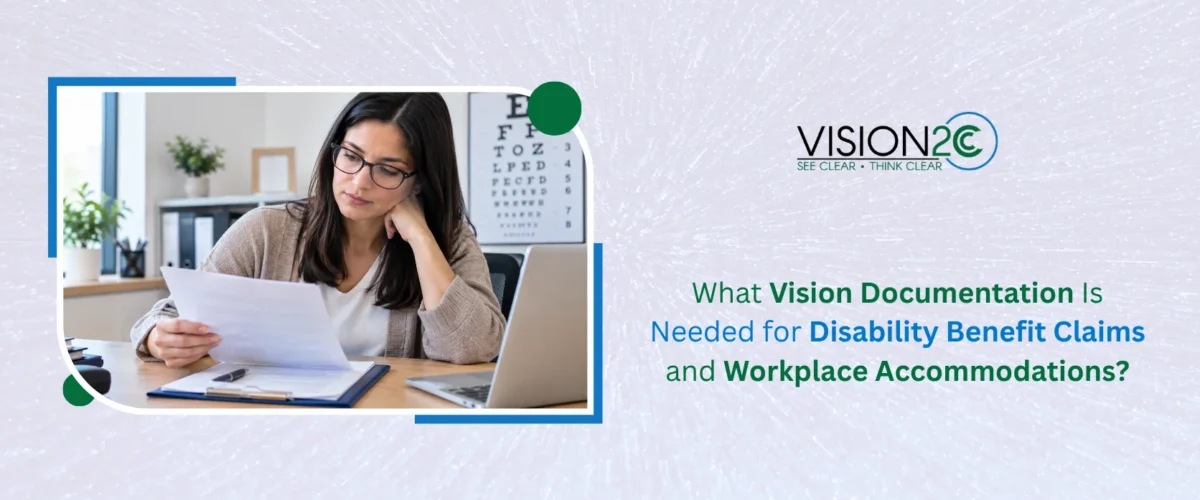
What Vision Documentation Is Needed for Disability Benefit Claims and Workplace Accommodations?

Navigating disability claims can feel like walking in the dark because the process is both scary and confusing. While the Social Security Administration provides disability payments and workplace accommodations, rehabilitation divisions within state Departments of Health provide low vision aids for the home and workplace. You might know your vision limits your daily life, but the government needs written proof through specific medical documents.
These agencies look for very clear test results to see exactly how much your vision stops you from working. They also look at how it affects reading or learning, so here we will show you exactly which papers you need to gather.
Without the right papers, the agency will likely reject your claim. That is a hard truth, yet you do not need to worry because you can get the exact help you need.

Why Proper Medical Evidence Is So Important

Proof. That is the magic word for any disability certification because you cannot just tell an agency that you cannot see well. You must physically show them, and medical evidence acts as your voice when reviewers look at your file. If your file is missing key tests, the reviewers will simply say no.
The U.S. government sets strict rules for legal blindness and low vision. You can read more about these exact rules on the official National Institutes of Health (.gov) website or the federal Social Security portal, where they explain why they need to see the real numbers from your eye exams.
Your records must show a long-term problem instead of a simple blurry day. The papers must prove your eye condition will last for at least one year and clearly show how this condition changes your ability to do normal daily tasks.

The Main Eye Tests You Must Provide

You will need a full and complete eye exam because a basic vision screening at a health fair is never enough. You need specific tests done by an eye care expert, so make sure your doctor includes these exact tests in your file:

  • Visual Acuity Test: This measures how clearly you can see letters from a distance using the standard eye chart. The agency looks at your vision in your best eye while you wear your everyday glasses or contacts.
  • Visual Field Test: This checks your side vision because some diseases make you lose your side vision while keeping your front vision clear. The government needs to know exactly how wide you can see.
  • Sensorimotor Exam: This test checks how well your two eyes work together, since reading and learning become very hard if your eyes do not team up well.
  • Eye Muscle Function Test: This looks for problems with how your eyes move and track objects during everyday activities.

Details Your Eye Doctor Must Write Down

Numbers are great, but words matter too. Your eye doctor must write detailed notes about your daily struggles because a page of test numbers is hard for a normal claims worker to understand. The doctor must translate those exact numbers into real-world problems.
Your final medical report should clearly list these items:

  1. Your exact eye disease or condition name.
  2. The exact date your vision problems started.
  3. A complete list of all the treatments you have tried so far.
  4. Notes on whether your vision gets better with glasses or surgery.
  5. A clear statement on how your vision limits your working, reading, or moving around safely.

If the doctor leaves out how the disease affects your daily life, the claim might stall. The reviewers need the full story to make a fair choice about your case.

How Vision 2C Supports Your Disability Claim

Choosing the right clinic changes everything because you need a doctor who truly understands the complex paperwork. At Vision 2C, our team knows exactly how to handle vision-related disability consultations. Dr. Marianna Konradi has spent over 15 years helping patients improve their vision by taking the time to sit with you and listen to your unique struggles.
Vision 2C offers comprehensive eye health services under one roof without ever rushing you out the door. We perform detailed sensorimotor exams and ocular disease management, ensuring we know exactly what testing boards and government agencies want to see in a medical file.
Whether you need documents for a workplace change or school test help, Vision 2C provides the exact forms required. We have successfully helped students get major accommodations like scribes for big exams while providing one-on-one personalized care in Brewer and Thomaston, Maine.

Simple Steps to Build Your Case

Starting the process takes a little planning, so you should follow these steps to build a strong file.

  1. Gather Old Records: Collect any past eye exams or hospital visits related to your eyes.
  2. Book a Specialist Exam: Call a dedicated clinic like Vision 2C for a full disability consultation.
  3. Explain Your Daily Life: Tell the doctor exactly what tasks are hard for you and never hide your daily struggles.
  4. Collect the Final Report: Ask for a printed copy of the doctor’s detailed letter and test results.
  5. Submit Your Claim: Send the full package to the agency or school board, keeping a copy for yourself at home in a safe place.

Getting Help for School and Standardized Tests

Disability claims are not just for monthly financial checks, as you sometimes need documents for school or workplace accommodations. Children and teens often struggle with hidden visual stress that can ruin their reading speed and test scores. Standardized tests demand intense focus, and students will suffer in silence if they have hidden vision issues.
A good eye doctor can write detailed reports for school districts and test boards to help prevent this. For example, some students need an aide to read questions aloud to them, while others need extra time or large print tests. Proper medical documents make these requests possible by pushing the school or testing board to give the student a fair chance.

Start Your Journey to Better Support Today

Waiting. It only makes the process longer and harder, since getting the right vision documentation naturally takes time. The sooner you book an exam, the faster you can submit your claim and get the fair chance you deserve at work or in school. Proper medical proof gives you that exact chance to succeed.
Take a deep breath, gather your questions, and reach out to a trusted eye care team to start your evaluation. With the right papers in hand, you can finally secure the accommodations and benefits you truly need for a better life.

FAQs

Q. What is a visual acuity test?

This test checks how clear things look from far away. It uses a normal letter chart.

Q. Why do doctors test side vision?

Some eye sicknesses make you lose side vision. The government needs to know exactly how wide you can see.

Vision Assessment

How Can a Functional Vision Assessment Help You Get Disability Accommodations?

Do you or your child fight a daily battle just to read clearly during a long day at work or school? Sometimes, prescription glasses are simply not enough to fix the underlying problem. You might be dealing with a hidden vision issue, one that makes learning or working much harder than it realistically should be. When this happens, a specialized eye test provides the undeniable evidence you need to secure extra support. This extra support is formally called a disability accommodation. We will explore exactly how a careful, in-depth eye checkup opens the door to helpful, life-changing adjustments in your academic or workplace environment.

What Is a Functional Vision Assessment?

A functional vision assessment is much more than reading random letters on a chart across a brightly lit room. While a basic eye check looks at how well you see far away, a deeper assessment investigates how your eyes actually work together as a team. The eye doctor checks your eye tracking, your focus and how your brain interprets the visual information it receives. If your eyes get exhausted quickly or frequently lose their place, the doctor documents this. This written report gives teachers or employers the exact medical details they need to truly understand your daily struggles.

Why You Need Proper Medical Proof

Schools and workplaces genuinely want to help people succeed. However, they cannot change their established rules without a documented reason. They need official paperwork from a trained eye doctor to prove you have a specific, verifiable need. A detailed report shows exactly what is wrong (and how it directly impacts your daily life). It takes all the guesswork out of the request process. When you have a solid medical report firmly in hand, it is much easier to ask for extra time on a test. The report essentially acts as your medical voice to explain your vision problems.

Common Signs You Might Need Extra Help

Many people do not realize they have a hidden vision problem. They just assume reading is naturally exhausting or slow for everyone. You might want to ask an eye doctor for a special exam if you notice these warning signs:

  • You get severe headaches when you read a book or look at a computer screen for an extended period.
  • The words look blurry or seem to physically move around on the paper when you try to focus.
  • You lose your place often and have to rely on your finger to follow the lines of text.
  • Your eyes feel incredibly tired or sore after just a few minutes of close-up work.
  • You skip small words entirely or read the same sentence twice without even realizing it.

How Accommodations Help at School and Work

Once you have your official vision report, you can request specific changes to make your day manageable. These changes level the playing field. Here are a few ways accommodations can help you every single day:

  1. More Time on Projects: You might receive extra minutes or hours to finish a critical test or a complex task.
  2. Special Tools: You could receive books printed with very large text, specialized lighting for your specific workspace, or video magnification.
  3. A Helpful Aide: A student might be assigned a helper who reads the exam questions out loud.
  4. Frequent Breaks: You may be permitted to rest your eyes regularly to prevent debilitating headaches.
  5. Audio Alternatives: You might receive text-to-speech software or a human reader.  

Standardized Tests and Vision Support

Big exams for professional licensing or college entrance exams are stressful enough on their own. This stress is magnified significantly if you have untreated visual stress that makes reading physically painful. Getting accommodations for high-stakes testing is a massive benefit of a functional vision assessment. Testing boards demand very clear, specific proof before they allow any exceptions to their procedures. A qualified eye doctor knows exactly what to write so that the board understands your needs. With the right approval, a student can perform with absolute confidence instead of fighting a losing battle against blurry words.

How Vision 2C Can Support Your Needs

At Vision 2C, Dr. Marianna Konradi and her caring team are ready to help you succeed. With more than fifteen years of experience in vision rehabilitation, Dr. Konradi knows exactly how to uncover hidden eye problems. The clinic offers specialized consultations designed specifically for securing educational and workplace accommodations.

The team at Vision 2C takes the time to listen to your worries in a welcoming environment. They provide the precise paperwork required by licensing agencies, school districts, or testing boards. Whether you visit their clinic in Brewer or Thomaston, Maine, you receive honest, individualized recommendations. Vision 2C ensures you never feel rushed during your important visit.

Taking the Next Step for Better Health

You do not have to struggle in silence with tired and hurting eyes. Booking a comprehensive exam is the absolute safest way to discover what is causing your reading problems. A clear diagnosis can change your life by unlocking the crucial support you need to thrive. If you want to learn more about how a thorough eye exam can help you or your child, reach out to a trusted eye care professional today. Taking action now helps you see clearly, learn comfortably and work with confidence.

FAQs

Q. What is a functional vision assessment?

It is a special eye test. It checks how the eyes work together as a team. It is not just about reading a chart on a wall.

Q. Can regular glasses fix hidden eye problems?

Not always. Regular glasses help someone see far away. But they might not fix eyes that get too tired when reading.

Vision

Why Do I Get Blurry Vision or Eye Strain When Reading During a Test?

Have you seen an important test paper and watched the words turn into a blur? You often blink and squint, wishing your eyes would help, but they don’t. Reading intently forces your visual system into absolute overdrive. You maintain a laser focus your body wasn’t designed to sustain. Add the crushing pressure of an exam, where every point feels like life or death, and your delicate visual hardware crashes.

Relax. That is the first step when the page blurs. Panic triggers tension, making visual stress worse. Let’s look at the science behind those exhausted eyes so you can reclaim your focus. Your vision shouldn’t block your academic success. Understanding the problem is the first step toward fixing it.

What Is Eye Strain and Why Does It Happen?

When your eyes get overworked, that’s called eye strain. It’s a lot like how your legs can feel worn out and heavy after some exercise. Your eyes can also feel this way since they use tiny muscles to achieve clear vision up close. When you stare down at a desk for a two-hour test, those microscopic muscles flex and lock into a rigid position without a second of relief.

Over time, these hardworking muscles fail and cramp up, just like a runner’s calf seizing on the final lap when pushed too far. This severe muscle exhaustion can suddenly make your vision blurry. Your eyes are asking for a break. If you ignore this, the pain will get worse. You could feel a sharp ache behind your eyes.

The Main Reasons Tests Cause Vision Problems

Taking a standardized test in a school building is an entirely different beast than casually reading at home. Exam environments create horrible conditions for your vision.

  • Poor Classroom Lighting: Schools frequently install the cheapest, brightest overhead lights. These fixtures beam intense light that bounces straight off white paper and into your retinas. This creates a blinding glare that exhausts your visual processing immediately.
  • Staring Without Blinking: When you concentrate fiercely on a complicated equation, your brain temporarily overrides your natural reflexes. Your blink rate drops. Less blinking leads rapidly to dry, itchy, and irritated eyes.
  • Holding The Paper Too Close: Anxiety changes posture. Stress makes you unconsciously lean forward. You bring the tiny print way too close to your face, forcing tired eye muscles to work twice as hard.
  • Hidden Mental Stress: Being nervous doesn’t just affect your stomach. It causes the muscles in your neck and shoulders to tighten into knots. This physical tension creeps right up into your sensitive eye area.
  • Visual Teaming Problems: Sometimes, your eyes simply do not work as a team. Doctors call this convergence insufficiency or oculomotor dysfunction. Your eyes struggle to aim and focus on a test paper or computer screen at the same time. Short breaks will not fix this. You may need specific eye exercises over time to restore single, clear vision. Getting proper testing accommodations is extremely valuable while you work on these skills.

Common Symptoms You Should Look For

It is crucial to recognize early warning signs before you hit a wall. You might not realize your eyes are actively struggling until a headache strikes. Pay attention to how you feel.

  • Words look totally fuzzy or physically jump and vibrate on the paper.
  • You feel a dull, throbbing headache creeping up behind your eyebrows.
  • Your eyes feel uncomfortably dry, burning, or scratchy—almost as if someone threw sand into them.
  • You lose your place while reading and have to start the sentence over.
  • You catch yourself rubbing your eyes aggressively, hoping physical pressure clears your focus.

Easy Tips to Protect Your Eyes During Exams

You don’t have to sit there and quietly suffer. Build these surprisingly simple habits right now to keep your vision feeling fresh until the final bell rings.

  • Follow the twenty-twenty-twenty rule. Every twenty minutes, look at something twenty feet away for twenty seconds. This gives those cramped focusing muscles a crucial break.
  • Write a tiny note at the top of your test reminding yourself to blink. It works absolute wonders for stopping dry eyes.
  • Sit up tall. Keep the paper an arm’s distance away to drastically reduce mechanical strain on your eyes.
  • Take five quick seconds to gently roll your shoulders and stretch out your stiff neck.

Keep in mind that extra testing time and frequent breaks are not always the best fix. For students dealing with high stress or neurological issues like ADHD, more time can actually backfire. Being stuck in a stressful testing room for longer periods can cause their attention to scatter. They can easily lose their sense of control in that environment.

How Vision 2C Can Help You Succeed

Sometimes, simple tips aren’t enough. If you constantly struggle with blurry vision during tests, you need a professional examination. At Vision 2C, Dr. Marianna Konradi and our team aim to help you see perfectly. We offer School Test Help services that target academic visual stress. We can evaluate your vision and produce a detailed report to ensure you obtain the necessary accommodations.

Students with learning differences also face hidden visual challenges. To understand this connection and get the clear vision you deserve, visit our ADHD page online. Call us directly at (207) 200-1492 today to book your next eye exam!

FAQs

Q. Do bright school lights hurt your eyes?

Yes. Very bright lights bounce off the white paper. This creates a bad glare that makes your eyes tired very fast.

Q. How does being nervous hurt your eyes?

Being nervous makes your neck and shoulders very tight. This tight feeling moves right up to your face and can make your eyes hurt.

How Does Depth Perception Affect the Way You See and Judge Distances

How Does Depth Perception Affect the Way You See and Judge Distances?

Imagine trying to catch a baseball as it flies through the air right toward your glove. You reach out and make the perfect catch! Or think about pouring a cold glass of water right to the very top without spilling a single drop.

These daily tasks feel so simple. You do them without a second thought. But a hidden superpower is actually doing the hard work. We call this skill depth perception, which allows you to see the world in three dimensions.

Flat, that is exactly how the world would look without this superpower, almost like a flat drawing on a piece of paper. You would have no clue if a car was ten feet away or a mile down the road and even walking down a normal set of stairs would be scary. Depth perception is how your eyes and brain team up to figure out space.

What Is Depth Perception?

Imagine your eyes as two small cameras that are only a few inches apart on your face. That small distance makes each eye capture a slightly different view of the world around you.

Try a quick game by closing your left eye and staring at a cup, then swapping by opening your left eye and closing your right. The cup jumps! This happens because each eye has a unique view.

Your brain receives both pictures at the same time and acts like a very fast computer. It mashes the two pictures together to make one single image (which is pretty amazing if you stop and think about it). This teamwork creates your 3D vision.

When your eyes work together, your brain easily judges space. This happens in a flash and if your eyes fail to work as a team, judging distance becomes a struggle without you even trying.

Why Do You Need Good Depth Perception?

You use this skill all day long to stay safe and move around your home without bumping into things. With solid 3D vision, you can fully trust what you see.

Here are ways you use this every day:

  • Driving a Car: You must know how far away the car in front of you is. Good vision tells you when to hit the brakes.
  • Playing Sports: Catching a baseball takes perfect timing. You have to know where the ball will land.
  • Walking Down Stairs: Judging the depth of a step keeps you from tripping.
  • Reaching for Objects: You need to know the exact distance to grab a cup safely.

When this skill is weak, life becomes frustrating and you may feel clumsy or bump into doors. Many people never realize that their bad balance is actually an eye problem.

How Your Brain Judges Distances

Your brain is smart and does not rely on just one trick to measure space. It looks for visual clues hidden in the world.

  • Size: Your brain knows the normal size of things. If a bus looks tiny, it is far away.
  • Shadows: Shadows give your brain clues about where a toy sits. A dark shadow tells you if a ball is floating or resting on the grass.
  • Hiding: Imagine a tree hiding part of a house. Your brain instantly knows the tree is closer to you.
  • Speed: Look out the window of a moving car. Mailboxes close to you zoom by in a blur – a clever trick of the eye, while mountains far away seem to sit still. Your brain uses this gap to measure distance.

Signs Your Depth Perception Might Be Off

Sometimes your eyes stop working perfectly as a team. When this happens, your brain gets easily confused and you might start to notice some strange warning signs.

Pay attention to these signals:

  • You have difficulty threading a needle.
  • You feel sick watching 3D movies.
  • You struggle to catch even a slow ball.
  • You get bad headaches after reading.
  • You find it hard to maneuver your car in traffic.
  • You feel visual stress while studying.

If you have these issues, please get help. Ignoring these red flags can lead to accidents, some possibly life-threatening.

How Vision 2C Can Help You See Better

Looking after your eyes helps keep your vision sharp and that’s what the folks at Vision 2C excel at. With locations in Brewer and Thomaston, Maine, they provide tailored care for everyone in your family without hurrying through appointments.

Dr. Marianna Konradi has more than fifteen years of experience. She has taught kids with vision problems. She enjoys helping people see better because she knows how poor eyesight can affect learning.

A normal checkup might not be enough since Vision 2C offers special Sensorimotor Exams that evaluate how well your two eyes work together.

Vision 2C also offers:

  • Routine Eye Exams: Simple tests to protect overall eye health.
  • Contact Lens Exams: Expert fittings for perfectly clear vision.
  • School Test Help: Support for students taking big exams.
  • Ocular Disease Management: Care for sick eyes.

Protect Your Vision Today

Your eyes provide you with a stunning perspective of the world. Excellent 3D vision ensures that life is both safe and enjoyable. Don’t overlook any clumsiness. Contact Vision 2C today to schedule an appointment. Allow our welcoming team to assist you in seeing clearly!

FAQs

Q. What is a Sensorimotor Exam?

It is a special eye test. A normal checkup just looks at eye health. This special test checks how well the two eyes act as a team.

Q. How does the brain judge distance?

The brain looks at clues like size. If a big bus looks very small, the brain knows it is far down the road.